• Skip to primary navigation
  • Skip to main content
  • Skip to primary sidebar

Rabia Gale

alchemical fantasy

  • Home
  • Works
    • The Reflected City
    • The Sunless World
    • Taurin’s Chosen
    • The Heartwood Chronicles
    • Stand-Alones
  • Newsletter
  • Blog
  • About Me
  • Contact

Search Results for: visual inspiration

visual inspiration online

My sister-in-law went to Tuscany and brought back pictures.

Speaking of awesome landscape pictures, here’s yet another plug for one of my favorite love-to-gawk-at  sites.

Via SF Signal: 40 examples of stunning space art. These images make me feel awed, insignificant, and sometimes disturbed. The artists have captured the vast scale and gigantic grandeur of space so well.

On an altogether different scale, I just love these drawings by Maria William. Oh, the detail.

I recently discovered iHanna’s Blog. This exploring pink journal is so cheerful and busy and full of sparkling life, it makes me want to do one of my own. (And I say this as a not-fan of pink. My color journal would explore greens and blues, especially the jewel tones that blend into each other!).

Where do you go if you need a little online visual inspiration?

Visual Inspiration #4

(Click on the links for parts one, two, and three.)

This workshop requires the use of a good visual dictionary. I have the DK Ultimate Visual Dictionary, but the Merriam-Webster one looks pretty nice, too.

Flip through the book, stopping at pages that interest you. Take a moment to study each double-spread, enjoy the images, read the labels. Keep a pen and paper handy to write down any ideas, associations, phrases or memories that occur to you.

Here are my impressions during this exercise, in real time:

The first pages that catch my attention are entitled Fungi and Lichen. I look at the diagrams and can’t picture myself writing about volva and globa and soprophores (at least not with a straight face). One of the pictures reminds me of the walk the kids and I took on which we found a piece of bark covered with lichen. My Right Brain starts spinning worlds where–instead of trees and plants–there are forests of mushrooms and meadows of lichen. Fungi need organic matter to feed on, so maybe I should put my lichenous world on a massive branch of a World Tree. Ah, yes. Yggdrasil. Norse mythology and giant-sized fungi–I could go for that!

Next up, the pages on medieval churches and Gothic architecture. I love architectural terms: flying buttresses, lancet windows (staggered triple lancet windows, no less!), cinquefoil molding. Now I actually get to find out what all those are! Recently I read an article about an actress who turned a 1910 Catholic church into a residence. What else might a Gothic church be used for, aside from religious services or as a tourist trap? A hospital or orphanage during wartime. Turned into a hotel by some enterprising billionaire. A shelter for homeless people, a meeting place for some kind of secret society. Converted into a high-tech dance club–or a Virtual Reality nightclub??–in a dystopian future. Ooh, I like that one.

My third example: pianos. Not too surprising, since I have pianos and the playing of them on my mind a lot (plus I need to practice right after I finish this!). Right Brain throws in all kinds of piano-related associations: the Holly Hunter movie, the poem Piano and Drums by Gabriel Okara, Sea Mist and Moonlight Sonata and Fur Elise. What a complicated instrument the piano is! RB sends up slices and slivers of Stories That Could Be: a missionary’s wife bringing a piano into the jungle, a fabulous piano maintained through dark sacrifices, a family of little Borrower-type people living in an abandoned old grand piano, someone calling a piano repairer in the middle of the night, insistent on having him come out to repair a piano right away and offering a lot of money to do it…

In this exercise–in all of them, actually–the visual images act as lenses to focus RB’s attention. They’re lightning rods that attract memories, trivia, news stories, snippets of literature. It’s a way to bring many ideas together around some connecting thread, in the hopes of sparking a story. I believe stories are born of the unexpected and unlikely marriage of two or more ideas that, at first glance, have nothing to do with each other.

Happy writing!

Visual Inspiration #3

I enjoy objects that are both beautiful and functional, thereby pleasing my aesthetic and practical sides. For this Visual Inspiration mini-workshop, I’m using three-dimensional arts and artifacts–furnishings, statues, pottery, plate settings, jewelry boxes, mirrors, masks, and more–to spark story ideas. Check out the Smithsonian website for tons of art to browse through. Pick something (or more than one thing) that catches your eye.

I’m going to use two examples, since I had a hard time picking just one.

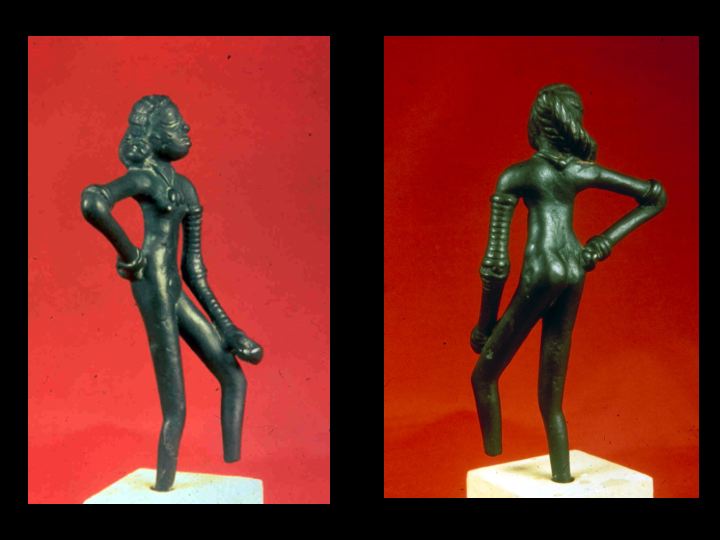
My first one is actually two statues from the Indus Valley civilization–the priest-king and the dancing girl. I have an emotional and familial connection to these pieces, since my father grew up close to the ruins of Mohen-jo-daro. I’ve walked in the excavated streets and peered down dug-up wells and peeped out through the windows of these old old buildings. I am intrigued by these ancient statues and the obvious and inferred disparity between them–disparity in power, gender, clothing (or lack thereof). Juxtaposing those two statues, I’ve had glimmerings of what might some day be a story–sacrifices, immortality, river dolphins, ritual, dance, childhood. The questions I’ve asked myself: Who are these people? Why were they important enough to make statues of? What rites and functions did the priest-king and dancing girl perform? And most importantly, how might they have related to each other?

Part of the premise of my current work-in-progress was sparked by Faberge eggs. I started with the following questions:

What is the purpose of this object? What other uses can I come up with? Faberge eggs are curiosities, intended to delight and surprise. But perhaps you could hide something in them. A small piece of jewelry, a will, a property deed, a love letter.

Who would own or use such an object? Somebody rich, powerful. Or someone obssessed or gifted with amazing artistic talent.

Who has it now? Here you can twist the answer to the earlier question. In my example, the egg has passed through the hands of a mafia boss, a pudgy accountant, and now is in the possession of water elementals.

Who wants this object and why? My protagonist, who is being threatened with the loss of everything she holds dear unless she recovers it. The people threatening her, who wish that the thing hidden inside never comes to light. The water elementals, who do wish the thing inside unleased.

Your turn!

Visual Inspiration #2

This is the second in my Visual Inspiration series–an intentional way of immersing yourself in images, giving your right brain plenty of opportunity to come up with ideas. Today I’m going to talk about using collages to spark a story. This is fun because you get to do, not just look. Get some scissors, a glue stick (less mess than regular glue), a sheet of paper and a stack of magazines.

This technique is simple: Go through the magazines and cut out pictures of anything that strikes your fancy. These could be images of objects, swatches of color, a cool pattern, a word or phrase, whatever. Once you have a bunch of them, try arranging them in different ways on your paper. You may find yourself abandoning some perfectly decent images because they don’t fit the mood of your collage. That’s fine. I had a nice looking Irish castle that I set aside because it was far too ostentatious and sunny to for the tone of my collage. Once you’ve picked your pieces and arranged them, glue them to the paper.

Here’s the one I did:

story collage
story collage

Now, ask yourself questions.

What is the mood of this collage? What adjectives jump to mind when you look at it?

Somber. Mysterious. Ancient. Hidden. Cold. Trapped. Feathered. Twilit.

What are the common elements in these pictures?

There are a lot of dark cool colors in here, purples and blues and greens.  A lot of stone–rocks on the beach, in the mosaic. Some of the patterns look like prints in stone. The feathers hint at brighter colors and warmth.

What are some of the surprising connections (these are what will spark the most interesting ideas because they suggest conflict)?

Why are the feathers in this collage? After all that brick and stone, they bring life and warmth, but it is a trapped life. I have this sense of a tropical bird far from home in a cold place, with mysterious life-draining rituals. And what’s with that college library with the lit windows on the left side? It doesn’t quite fit the collage, as if there were two timelines or stories running parallel to each other, intersecting only… where? With the finding of a stone artifact or a feathered cape?

… and so on.

Again, the answers to those questions will spark more questions. Follow these rabbit trails. Be inspired.

Till next time.

  • Go to page 1
  • Go to page 2
  • Go to Next Page »

Primary Sidebar

  • Email
  • Pinterest
  • RSS
  • Twitter

Join the Mailing List

I send out monthly newsletters, and share some special content with subscribers only. Join me!

This field is for validation purposes and should be left unchanged.
(Required)

Search

Categories

© 2026 Rabia Gale | All Rights Reserved | Design by Robin Cornett | Header Artwork by David Revoy: Used with permission | Privacy Policy